Who Decided?
When AI influences, executes, or acts within a consequential workflow, accountability still belongs to the organization and its people.
Judgment Assurance is a decision-governance discipline that establishes who authorized the system, what it was permitted to decide or do, when human judgment was required, what evidence shows that authority was exercised, and what patterns emerge across thousands of decisions that no individual record can reveal.It applies whether AI recommends an outcome, executes a decision automatically, or acts across a sequence of steps.For the complete framework and underlying theory, read the JA whitepaper or explore the document suite on the home page.
See It in Action
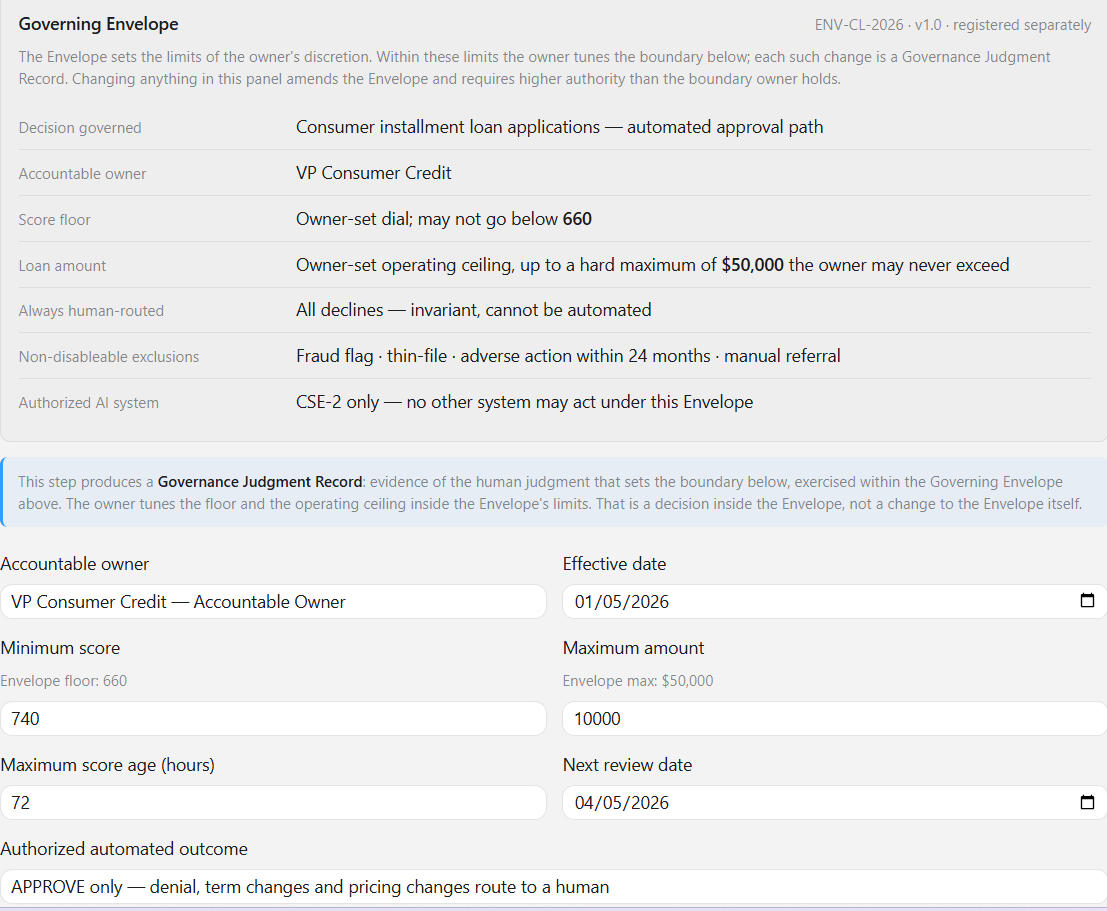
The demo walks through a lending decision in six steps.First, an authorized owner defines the Envelope: the conditions under which the system may operate, the limits of its delegated authority, and the circumstances that require human intervention.A case then enters the workflow and is evaluated against those boundaries.Some cases may fall within previously authorized parameters and execute automatically. In those cases, the system records the governing Envelope, the relevant inputs, and the action taken.Other cases require human judgment. In that branch, the AI may recommend an outcome, but the recommendation is not itself the final decision. An authorized person must accept, modify, or reject it and record the basis for that judgment.Tier A reasoning captures straightforward, observable judgment: the score was consistent with policy, required information was present, and no disqualifying conditions appeared.Tier B reasoning captures the harder judgment: relevant context the system could not access, an unusual regulatory constraint, conflicting evidence, relationship history, or another factor requiring analysis beyond the model output.
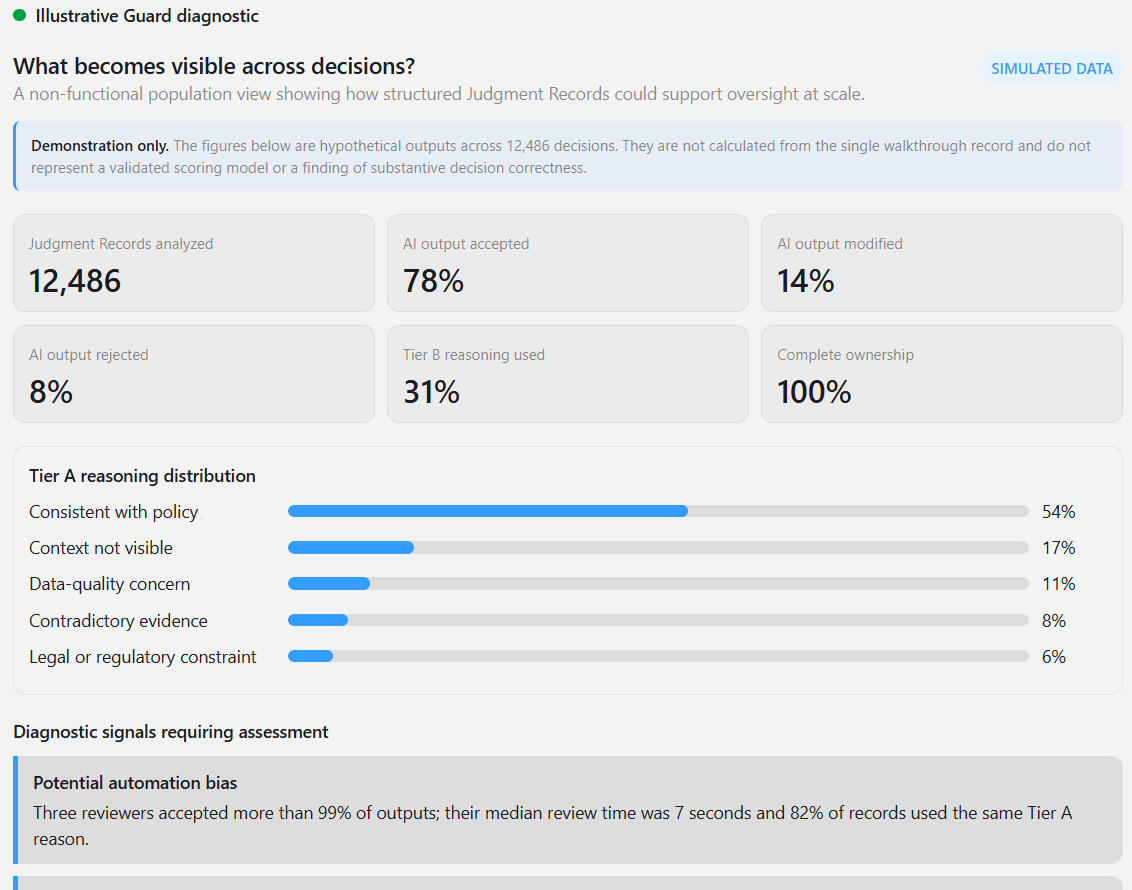
A free text field is available to capture other relevant context or information.Once completed, the decision record is sealed with a cryptographic hash so that later alteration becomes detectable.Once many decision records accumulate, Guard examines them at population scale.That broader view can surface patterns no isolated record reveals: reviewers whose conduct is consistent with rubber-stamping, changes in override behavior following a model update, high-risk cases supported only by generic narratives, recurring boundary exceptions, or other signals that warrant further investigation.That is where governance becomes auditable across the system rather than only within a single case.
Define the Envelope: Establish the conditions for automation and human intervention.
Examine the Population: Surface review patterns, drift, and control weaknesses across accumulated records.
Built for More Than Recommendations
Agentic systems are AI systems authorized to pursue an objective through a sequence of actions, tool uses, and intermediate choices—not merely produce a single recommendation.As that authority expands, the Envelope governs not only what the system may decide, but what it may do, which tools it may use, and when it must stop or return control to a human.
Built on Four Principles
Judgment Assurance operationalizes a four-step decision-governance discipline: Define, Record, Own, and Guard.
Define
Establish the Envelope: who owns the workflow, what the system may recommend, decide, or do, which tools and data it may use, and when human intervention is required.The Envelope determines what the system may decide, what it may do, and when a human must intervene.
Record
Capture the recommendation, automated action, or human judgment together with the governing Envelope and relevant evidence.In agentic workflows, the same discipline extends to the objective assigned, actions taken, tools invoked, limits encountered, and points of escalation or human intervention.For human-reviewed matters, the record shows who exercised judgment and why.For automated matters, it shows which preauthorized condition permitted execution.For agentic matters, it can capture the objective assigned, the actions taken, the tools invoked, the limits encountered, and the point at which escalation occurred.This is the Atomic Unit of Judgment Assurance: an attributable record showing how delegated or exercised authority was used in a particular case.
Own
Attribute the workflow, system activity, and any human judgment to the authority responsible for them.Every record identifies the system involved, the governing Envelope, and the human or organizational authority responsible for the workflow.Accountability is not left in a policy document. It is embedded in the evidence itself.
Guard
Examine accumulated records at population scale for automation bias, model drift, weak reasoning, recurring exceptions, boundary pressure, anomalous tool use, and failed escalation.Guard can also support two distinct forms of control testing.Blind reviews withhold the AI recommendation from the human reviewer, allowing the organization to test whether the reviewer reaches an independent judgment or has become overly dependent on the system output.Seeded test cases introduce known cases into the workflow to test whether the system and review process correctly identify expected approvals, rejections, escalations, false positives, and false negatives.Together, these controls test both the independence of human judgment and the performance of the decision system when its controls are actually challenged.This is where structured governance stops being theater and becomes auditable.
Built on Open Schemas
JA-ES is an openly licensed JSON Schema suite for structuring governance boundaries, human-reviewed decisions, and automated execution evidence.The current schemas support:
Governance judgment records establishing an authorized Envelope
Case-level human judgment records
Auto-execution logs linked to the boundary that authorized them
Structured Tier A and Tier B reasoning
Evidence showing why a case was routed to human review
Permitted and prohibited automated actions
Escalation and ownership metadata
Tamper-evident record integrity and chain linkage
Probe metadata that can support controlled Guard testing
JA-ES includes a verifier for confirming record integrity and a test suite containing valid and invalid examples.The current release focuses on decision evidence and bounded automated execution. The broader Judgment Assurance framework also applies to agentic and multi-step workflows, where future or domain-specific schemas can capture objectives, action chains, tool use, intervention points, and escalation behavior.Everything is licensed under CC BY 4.0.
GitHub repository →
github.com/judgmentassurance/ja-esZenodo DOI →
10.5281/zenodo.21501112You may fork, modify, and integrate the schemas into your own systems. There are no proprietary licensing restrictions and no vendor lock-in.
Share Your Feedback
Judgment Assurance is an open framework, and practical feedback is part of how it improves.Tell us what was clear, what was missing, where the framework may be useful, or where it does not yet fit the realities of your work.
© 2026 Judgment Assurance Institute, LLCAll rights reserved.